Pages

Wednesday, 26 May 2021

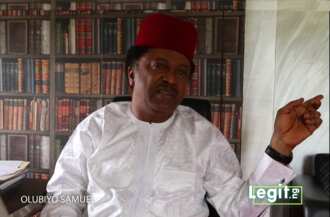
Sultan in Danger over Recovered Loot Remark? Shehu Sani Expresses Fears


The question about the whereabouts of recovered loots directed to the federal government by the Sultan of Sokoto, Muhammadu Sa'ad Abubakar III, has been described as pebbles thrown at the leadership

Shehu Sani, a former senator from Kaduna Central, on Wednesday, May 26, expressed fears that this might turn against the Islamic leader.

Sultan in Danger over Recovered Loot Remark? Shehu Sani Expresses Fears

It is the hope of Shehu Sani that the Sultan will not be attacked for his question

In his tweet on Wednesday, although Sani did not mention actual names, he implied that presidential media aides might come for the Sultan as in the case of Father Mbaka of Adoration Ministry Enugu Nigeria (AMEN) and Bishop Mattew Kukah.

"The Sultan has thrown a Pebble into the Palace; hope the guards would not chase him hard with machetes, like Mbaka and Kukah."

Earlier, Sa’ad Abubakar III on Tuesday, May 25 urged the federal government to explain to Nigerians how much loots it had recovered and what they were being used for.Sani said:

He spoke in Sokoto at the zonal dialogue with stakeholders on the National Ethics and Integrity Policy, for the northwest zone.

The Sultan, represented by the Wazirin Sokoto, Professor Sambo Wali Junaidu, said keeping mute on the recovered loots would spell doom for the fight against corruption in the country.

The cleric was quoted to have said:

“The government owes Nigerians an explanation, we want to know how much billions of naira was recovered from our past leaders. Where the monies are and what are they doing with them?
He said the founders of the Sokoto Caliphate had written many books on corruption and how it could be addressed using Islamic ways.“This explanation is necessary considering the state of our education and other infrastructure like roads which need serious government attention.”

Nigeria's President Muhammadu Buhari reacted to the historic appointment of Professor lbrahim Abubakar


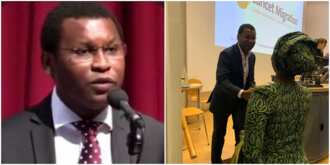
A Nigerian professor Ibrahim Abubakar has bagged a new role as the Dean of Faculty of Population Health Sciences of the University College London, a statement from the university confirms.

The well-read academic with an MSc from the London School of Hygiene and Tropical Medicine will take over from Professor Graham Hart who has held the position since August 2011.

Nigerian Professor Appointed New Dean of Renowned University College in London, Buhari Reacts

Professor Ibrahim becomes the second Dean of the faculty Photo Credit: @ProfIAbubakar, @ToyinSaraki

A statement from the university confirming the appointment which will take effect from August 2021 reads in part:

“He successfully leading the faculty to its position today as a leading global institution for education and research in public health and clinical medicine, consistently ranked in the world’s top ten. Professor Hart will continue to co-direct UCL Health of the Public.“We are delighted to announce that Ibrahim Abubakar, a world-leading scholar in the field of infectious disease epidemiology, will take up the post of Dean of the UCL Faculty of Population Health Sciences from 1 August 2021.
“He has published widely, including over 300 research papers, policy reports, book chapters and textbooks. He has a strong commitment to equality and diversity, supporting excellence in education and research and tackling inequalities and social exclusion.”

President Buhari has reacted to the appointment.

Speaking through his media aide Malam Garba Shehu, Buhari hailed Ibrahim for his unalloyed support to public health institutions that has seen significant progress in the area and congratulated him on his appointment.

Meanwhile, two Nigerian-Americans were elected into the US National Academy of Engineering.Ibrahim holds a bachelor's degree in medicine from Ahmadu Bello University. He was elected Fellowship of the Academy of Medical Sciences in 2020 amongst other impeccable achievements recorded in his career

Both Soboyejo and Olukotun were among the 104 new members and 24 international members elected to the NAE in March 2021. Olukotun is a professor of electrical engineering and computer science, Stanford University, Stanford, Calif.

He earned his place at the academy following his contributions to on-chip multiprocessor architectures and advancement to commercial realization.

Sunday, 25 April 2021

God's Ageda for Nigeria - Stainless Elijah

 Agitations, self-determinations or succession. Nigeria government urge to listen to the voices of the wisdom and do the needful to safe the nation from the socio economic sucidal problem.

The God's own president and spiritual head of the World Stainless Church. Stainless Oluwakayomide Elijah drop the hints while delivering his spiritual prophecy tittle " God's Agenda for Nigeria'.

Stainless Elijah stated that the Nigeria  government need to critical look on the populace demands and do all within it's power to address the anomaly and give equal treatment to the citizenry.

The spiritualist observed that. God love Nigeria, but in order not to misuse the opportunity, our leaders need to have fear of God in all their endeavours.

He claimed that restructuring the country through physical federalism is the God's best option for Nigeria.

Adding, "nepotism, corruption will continue to have negative effects on the image of this country and the citizens. "Nigeria is at the safe angle  if those at the corridor of power takes God words.

While frowned at the prophets of doom. Stainless Elijah urge Nigeria President Buhari to  strive on economy and security and prevent the nation not to suffer hyperinflation which may cause bad effects.


Saturday, 24 April 2021

Gov. Sanwo-Olu launches 5 yrs. Agric and food security roadmap


The Lagos State Governor, Sanwo-Olu has launched a 5 years Agricultural and Food Security Roadmap.

Speaking at the ceremony the governor noted that at the inception of his administration in May 2019, he identified food security as a major policy thrust of his Government and a key component of T.H.E.M.E.S Agenda, and confirm that the 5-year Agricultural Roadmap has been designed in line with Agenda, to reform, transform, and maximize the potential of Lagos State’s Agricultural Sector.

Lagos State according to him with a population of 22 million people is Nigeria’s commercial capital but it has the smallest landmass among the 36 States of the Federation. 

But as well rely on massive food importation from neighbouring states to sustain the food requirements of the teeming population, through collaboration with other states, to ensure food sustenance in the state.

 An approach that resonates with global best practices and enables optimal levels of planning, advocacy, funding, and collaboration for agricultural development.

The governor emphasize that now is the right time to unlock  the immeasurable agricultural potential through the implementation of the 5-year roadmap that will lead to wealth generation, value creation, food security, the industrialization of agricultural sector and the entrenchment of inclusive socio-economic development.

Governor Sanwo-Olu however lamented that as a visionary government, committed to optimally developing potential in food production. The adverse effects of the coronavirus pandemic on food security have necessitated immediate action on ensuring food security for all Lagosians.

Stressing  that with the human and capital resources at our disposal, "we should be able to feed ourselves (and even possibly the Nation) by becoming self-sufficient in food production and supply, and engender sustainable growth through the development of the agricultural sector."

The step towards achieving this according to the governor is the preparation of a Five-year Agricultural and Food Security Roadmap, focus of the 5-Year Agricultural and Food Security Road Map, the development of agricultural value chains where Lagos State has competitive and comparative advantages to enhance the State’s self-sufficiency in food production from 18% to 40% over the next five years, and achieve the Sustainable Development Goals (SDGs) in Lagos state andtake a cue from other economies that have achieved self-sufficiency in food production. We will also aim to put the private sector at the heart of our vision for food security in Lagos State, with government as enabler and catalyst.

We are cognizant of the fact that we must formulate policies that can encourage private sector investment in agriculture and must provide robust market information systems for Agricultural Value Chain actors, for adequate planning and the circumvention of risks and uncertainties.

Our strategies for sustainable Agricultural Dqevelopment shall focus on growing the upstream sector through interventions by leveraging technologies that are capable of lowering the cost of production of value chains (Fisheries, Poultry, Piggery, Rice, Vegetables and Coconut) with support from donor agencies.

Growing the midstream and downstream sectors (value addition involving: processing, handling, storage, cold chain, packaging, utilization and commercialization) of all important agricultural value chains by leveraging on the huge market with support from donor agencies.

And Improving private sector participation by developing and initiating policies that will encourage more private investment in agriculture. This will include linking the private sector with business-friendly credits. He concluded.

The projection is that the total investment in the Agricultural Sector from the government, private sector, donor agencies and development partners will run into over $10Billion in the next five years. While we expect most of the investment to be private sector-driven, government will continue to provide the needed infrastructure while the private sector will be encouraged to lead the key projects.
Thursday, 15 April 2021

Presidency Reacts as Super Eagles Captain Ahmed Musa Officially Joins Kano Pillars


Bashir Ahmad, a personal assistant to President Muhammadu Buhari on New Media, has applauded Super Eagles captain Ahmed Musa for joining Kano Pillars until the end of the season.

Nigeria Professional Football League club Pillars announced they have signed the former Leicester city forward on a short-term deal, with Bashir Ahmad describing it as ‘smart move’.

Musa will play with the Kano based team until the end of the 2020/2021 season where he scored 18 goals having had a stint there in 2009.

The Nigerian international has been without a club after leaving Al Nassr of Saudi Arabia last year’s October.

Reacting to Musa’s move.

 Bashir Ahmad via his twitter handle on Wednesday, welcomed the former CSKA and Leicester City forward back to the NPFL.

He wrote:

“Kano Pillars FC have agreed to sign its former player and Super Eagles captain,

 Ahmed Musa, for the rest of the 2020/2021 Nigeria Professional Football League (NPFL) season. Smart move by the ‘Sai Masu Gida’. Welcome home Ahmed Musa718.”

Musa however disclosed that he moved to the local club instead of being idle in Europe. 

Ahmed Musa earlier hinted that he would definitely return home to play for a club to help raise the standards of the Nigeria Professional Football League.

In an exclusive chat during his time at Al Nassr of Saudi Arabia, Musa who has shown a lot of patriotism for Nigeria also urged current and ex-national team stars to endeavour to, at least, play for a season in Nigeria.

Musa left Riyadh based club Al –Nassr in 2020 with two years remaining of the four-year contract he signed when he joined from Leicester City.

Several clubs in England including West Brom are reportedly interested in the 29-year-old who remain Nigeria’s record scorer at the World Cup with four goals.

Presidency reacts as Super Eagles captain Ahmed Musa officially joins Nigerian club Kano Pillars

Photo: Ulrik Pedersen

Musa said:

“It’s better than hanging and idling in Europe. There will always be a place for you at home.
“Anything that improves the image of Nigerian football is something that I strive to embark on and Kano Pillars holds a special place in my heart.
“It’s the team that helped me become the professional footballer I am today, so this is more than just football but a very strong bond.”

IGP disbands police monitoring units in Lagos, Port Harcourt


The acting Inspector-General of Police (IGP), Usman Alkali Baba, has ordered the immediate disbandment of the IGP monitoring satellite offices in Lagos and Port Harcourt.

The police boss gave the order after Nigerians complained that the officers in the units were harassing them and operating beyond their briefs.

IGP disbands police monitoring units in Lagos, Port Harcourt, gives reason

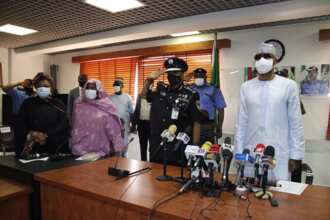
IGP says he will improve from where his predecessor has left. Photo: @PoliceNG

He made the disclosure on Thursday, April 15, at his maiden meeting with command police commissioners and zonal Assistant Inspector-General (AIG)'s in Abuja.

Baba said the disbanded units will be re-organised.

The IGP took the action 24 hours after he met with Musiliu Smith, chairman of the Police Service Commission (PSC), to discuss ways of increasing the efficiency of the police force.

Meanwhile, the IGP Baba has disclosed that the security situation in the southeast and south-south geopolitical zones in Nigeria is critical to his tenure. 

Baba disclosed this on Friday, April 9, in Abuja at the opening of a meeting with police strategic commanders in the zones.

He said the meeting was aimed at discussing security issues affecting the two regions of the country. Baba noted that after the meeting, the commanders would go back to their zones to implement the outcome of the meeting.

In another report, some unknown gunmen have killed three police operatives in Abakaliki, the Ebonyi state capital.

According to the report, the operatives were shot while on duty at about 7:30 pm on Wednesday, April 14 along Nwezenyi road in the state capital.

The officers who sustained bullet wounds during the attack were later confirmed dead by doctors at the Alex Ekwueme Federal University Teaching Hospital Abakaliki. Commissioner for internal security and border peace, Stanley Okoroemegha, confirmed the incident.

Royal Dutch Shell Lowest Payout to Nigerian Government in Three Years


Royal Dutch Shell subsidiaries' payment to the Nigerian government declined last year as the company paid less when compared to the previous fee disbursed. In 2020, the company paid $3.24 billion.

The reduction in Shell's payment was also recorded in other countries where the company operates. However, the payment made to Nigeria is the highest payout from the oil and gas company to 24 nations last year.

But when compared to the preceding years, the combined payment of the subsidiaries to Nigeria dropped from $6.39 billion in 2018, to $5.63 billion in 2019 and $3.24 billion.

Royal Dutch Shell Makes Lowest Payout to Nigerian Government in over Three Years

Shell tanker. Photo: Yegor AleyevTASS

The last time Shell paid lower than $4 billion to the Nigerian government was in 2016 and 2014, when the company disbursed $3.64 billion and $3.02 billion respectively.

According to the company's report on Payments to Governments Report for the Year 2020, the Nigerian National Petroleum Corporation received $2.28 billion last year, against the $3.77 billion in 2019.

Federal Inland Revenue Service got $440.39m as taxes from the company in 2020, lower than the $1.28 billion of 2019. These are some of the payouts from the company which suffered a loss of $21.68 billion last year, in contrast with the $15.84 billion profit Shell recorded.

Meanwhile, the Central Bank of Nigeria (CBN) has received a court order from the Federal High Court to freeze the accounts of companies and persons.

The affected are eleven in number. The CBN had made the request last month in order to restrict the financial activities of the companies. It was stated on Wednesday, April 7, 2021, that the order had been given.

According to a statement from the financial regulator, the request to freeze the accounts was due to suspicious activities which the CBN intends to investigate.

Economy : Nigeria records highest inflation rate in four years


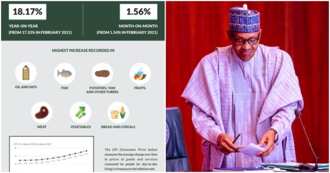
Nigeria’s inflation rate increased by 18.17 % (year-on-year) in March 2021.

Trouble for economy as Nigeria records highest inflation rate in four years

The COVID-19 pandemic dealt a blow to the Nigerian economy. Photo: @sgyemikale/Twitter, Femi Adesina/Facebook

This is 0.82 % points higher than the rate recorded in February (17.33 percent), which makes it the highest reported in four years since April 2017.

The National Bureau of Statistics (NBS) reported the new figure in its Consumer Price Index (CPI) March 2021 report released on Thursday, April 15.

According to the NBS report, increases were recorded in all Classification of Individual Consumption by Purpose (COICOP) divisions that yielded the headline index.

On a month-on-month basis, the headline index increased by 1.56 % in March 2021.

This is 0.02 percentage points higher than the rate recorded in February 2021 (1.54 %).

The percentage change in the average composite CPI for the 12 months period ending March 2021, over the average of the CPI for the previous 12 months period was 14.55%, representing a 0.50% point increase over 14.05 % recorded in February 2021.

The urban inflation rate increased by 18.76 % (year-on-year) in March 2021 from 17.92% recorded in February 2021, while the rural inflation rate increased by 17.60 % in March 2021 from 16.77 % in February 2021.

On a month-on-month basis, the urban index rose by 1.60 % in March 2021, up by 0.02 compared to the rate recorded in February 2021, while the rural index also rose by 1.52 % in March 2021, up by 0.02 compared to the rate that was recorded in February 2021 (1.50 %).

This is higher than 14.66 % reported in February 2021, while the corresponding rural inflation rate in March 2021 is 13.99 % compared to 13.48 % recorded in February 2021.The corresponding 12-month year-on-year average percentage change for the urban index is 15.15% in March 2021.

Meanwhile, the claim that Nigeria printed N50-N60 billion last month to cushion its financial trouble has been denied by the federal ministry of finance, budget, and national planning as well as the Central Bank of Nigeria (CBN).

P.M News reports that Osita Nwanisobi, the spokesperson of CBN, on Sunday, April 11, said he was not aware of any money printed by the government. He disclosed this while speaking to journalists.