Pages

Monday, 19 March 2018

Cirque du Soleil performer Yann Arnaud falls to his death


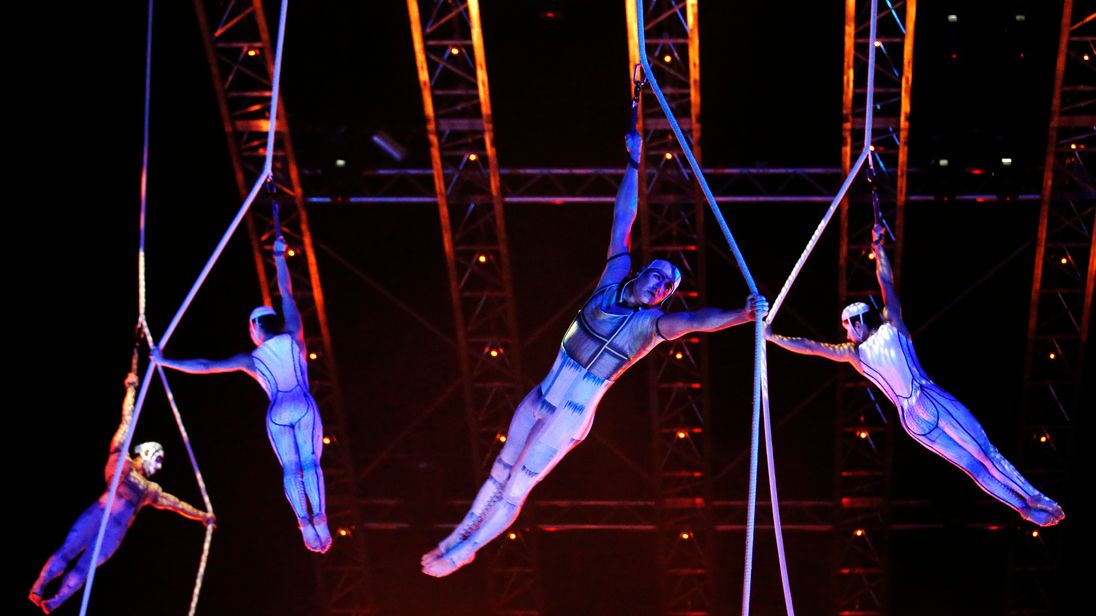
Cirque du Soleil, at the Royal Albert Hall in London, 2014
Image:Cirque du Soleil in 2014.A Cirque du Soleil performer has died after falling onto a stage at a weekend show in Florida.
Yann Arnaud, 38, had been performing in Cirque shows for 15 years and was one of the company's most experienced entertainers, according to president and chief executive Daniel Lamarre.
Mr Arnaud, who was French and married with two young children, fell during an aerial straps routine during Saturday's performance of the show VOLTA.
According to local media reports, Mr Arnaud appeared to lose his grip on a strap before he fell, bringing the show to a haltHe died at a nearby hospital.
Speaking from Tampa, having travelled to be with the show's cast, Mr Lamarre said: "We were very surprised, considering his experience, that something like that happened.
"I cannot describe to you how the people feel.
"It's terrible."

Yann Arnaud with his wife
Image:Yann Arnaud with his wife
Julian Martinez, who witnessed the accident, told local TV station WFLA: "It was awful."You heard all the cries of the audience.
"There were children there and they were freaking out."
Mr Lamarre said the routine was seen as relatively safe but Mr Arnaud's death is the third involving a Cirque performer in the company's 34 years.
In 2013, French acrobat Sarah Guillot-Guyard, 31, died after falling around 15 metres as she was being hoisted up toward the roof of the stage during a Las Vegas show.
In 2009, Ukrainian acrobat Olexandre Jourov, 24, died from a fall during a rehearsal in Montreal.
Speaking on Mr Arnaud's death, the company said in a statement: "We are offering our full and transparent collaboration to the authorities as they look into the circumstances of this accident.
The last two shows in Tampa, planned for Sunday, were cancelled.
The US Occupational Safety and Health Administration is investigating Mr Arnaud's death.

Sponsored Links

Lassa fever: Rural dwellers believe rats have high nutritional value - Ebonyi official

In an effort to prevent further outbreak of Lassa fever, Ebonyi government is to begin intensive campaigns against rat consumption in rural areas where inhabitants erroneously believe rats have high nutritional value.
The state commissioner for environment, Chief Donatus Njoku, told the News Agency of Nigeria (NAN) on Monday, March 19, in Abakaliki that the government would explore all avenues to dissuade the citizens from consuming rats.
NAN reports that Lassa fever outbreak in the state in January resulted in four deaths.
Njoku said: “Rats are the primary vectors of the disease, and we are vigorously carrying out enlightenment through mass media, workshops, seminars and various ministries’ communication channels.
“We will collaborate with traditional rulers and other opinion leaders at the grassroots to educate rural dwellers to shun such a notion and realise that rat is the disease’s primary vector.
“We have also continued to sensitise the populace to urgently report suspected cases to relevant health agencies.
“With the total functionality of the state government-owned southeast Virology Centre, such an occurrence can be expeditiously handled.’’
On sanitation, Njoku said that contrary to insinuations, non-observance of the monthly sanitation in the state did not affect effective sanitation.
“State and federal government functions sometimes fall on the last Saturday of the month, and when this occurs, we have to comply.
“The state government has evolved policies which make the populace to clean their environments on daily basis and not wait for designated days,” he said.
Njoku told NAN that the state Ministry of Environment ensured that state government ministries and parastatal-agencies cleaned their environments daily as directed by the governor.
“We assess their performances to ascertain the level of compliance; to show his seriousness toward the directive, the governor visits the ministries for on-the-spot assessments.
“We encourage the people to keep their environments clean to improve their health,” he said.
Meanwhile eight people have been confirmed dead in Katsina state as a result of an outbreak of Cerebro-spinal Meningitis. This was disclosed by the Katsina state commissioner for Health, Mariatu Usman, confirmed this via a text message on Sunday, March 3.

Benue bride gets emotional at her wedding, breaks down in tears

 A Nigerian bride was captured on camera after she broke down in tears on her wedding day.
The emotional Nigerian wedding ceremony that went viral on social media. The wedding which took place in Benue saw a beautiful bride break down in tears as her family members proceeded to hand her over.
The beautiful bride identified as Nguemo Agera was captured as she broke down in tears on her wedding day. The bride who was said to have been excited to get married to her husband, Trever, got emotional as she was being given to her husband.
It was gathered that young Agera is from konshisha local government area, Benue state and the groom id from Gwer East, also in Benue.
emotional bride cries at her wedding
Benue bride gets emotional at her wedding, breaks down in tears Photo source: Facebook user Chivir Nyam
The photos of the emotional bride at her wedding went viral after they were shared on Facebook. The photos were shared by Facebook user Chivir Nyam.
Nyam wrote: “The family of Terhemba Fidelis Agera Kume of konshisha LGA on Saturday gave their daughter's (former Miss Nguemo Agera) hand in marriage to Mr Terver from Mase people of Gwer East. May the good lord blessed the marriage and let them be fruitful in Jesus name.
I wish you happy marriage life Mrs Nguemo Agera Terver.”
More photos below:
emotional bride cries at her wedding
She was dressed in black and white traditional wear Photo source: Facebook user Chivir Nyam
emotional bride cries at her wedding
Benue bride gets emotional at her wedding Photo source: Facebook user Chivir Nyam
emotional bride cries at her wedding
Benue bride breaks down in tears Photo source: Facebook user Chivir Nyam

Nigerian leaders have abandoned public schools - El-Rufai

Governor Nasir el-Rufai of Kaduna state recently said in Zaria that a survey conducted by the government revealed that Nigerian leaders who were trained in public schools have abandoned such schools. The governor said that this has led to the collapse of public education in Nigeria generally.
The governor stated this at the 25th annual general meeting of the Zaria Education Development Association (ZEDA). He referred to the situation as being unfortunate.
He stated: “Why is it that in the last 30 years or so various governments, both military and civilian, have failed to invest in education? How come all of us that were quality products of public education somehow abandoned it? How many of us have enough confidence in our public school system to send our children there?”
He said his government has decided to make a difference in the state. El-Rufai remarked: “We collectively took a decision that no matter what it takes, no matter what it costs, we will restore good public education.”
Professor Idris Abdulkadir, the chairman, ZEDA board of trustees, in his listing of the organisation's achievements in the last 25 years, mentioned the establishment of 100-seater capacity digital training centre, development of infrastructure, and the training of over 5,000 youths on various vocations.
Meanwhile.Kaduna wing of the Nigeria Union of Teachers had called off the indefinite strike action embarked upon.
The chairman of the union in Kaduna state, Comrade Audu T. Amba, disclosed this on Thursday, January 18, shortly after an emergency meeting of the State Wing Executive Council (SWEC) which was held at the teachers end well hotel in the state.

Nigeria to generate 100,000mw by 2030 - ECN

The Energy Commission of Nigeria (ECN) on Monday, March 19, predicted a growth of up to 100,000 megawatts electricity generation in the country by 2030.
Professor Eli Bala, the director general of the ECN, disclosed this in an interview in Abuja, the News Agency of Nigeria (NAN) reports.
Bala said that the projection would be possible with an annual economic growth rate of 7% and steady implementation of the national energy plan by the Federal Ministry of Power, Works and Housing.
“With the incremental power programme; every time, every year, we must have an increment in power generation.
“We will also increase our capacity to transmit as well as the capacity to distribute.
“So I think we are on course, although it is not easy.
“Very soon, we will get to a level where we will have a 100,000 megawatt or 100 gigawatts by 2030 and the economy growing at the rate of about 7% annually,” he said.
Bala, who said the legal mandate of the commission is to produce strategic plans and coordinate national policies, stressed that “for you to have something, you must plan for it.
“If you look at the strategic plans we have produced, we produced energy master plan and in particular with respect to electricity generation.
“We were the first to articulate the various energy mix including what I have told you; renewable and also the nuclear.
“We made a plan in such a manner that we project by 2030, if the economy is to grow at 7%, we need nothing less than 100 gigawatts of electricity capacity.
“And also, you know our politicians want the economy to grow by double-digits. If the economy is to grow by double-digit, we need nothing less than 300 gigawatts by 2030.
“I think knowing what you want is a very important thing. If you don’t know what you want, you are going nowhere,” he said.
Earlier the minister of power, works and housing, Babatunde Fashola, said that the country now has the capacity to generate not less than 7,000 Megawatts (MW) of electricity.
Fashola, who was responding to questions at a forum in Abuja, also said that transmission chains had also developed the capacity to transmit the same megawatts.

Friday, 16 March 2018

EFCC charges Bellview and First Nation airlines with N1.7bn fraud, arraigns them in court

The EFCC, according to our source report joined the managing director of First Nation Airlines, Kayode Odukoya, as the defendant in the four-count charge bordering on forgery, use of forged documents, perjury and stealing.
According to the anti-graft agency accused the defendants of forging the memorandum of loss of Lagos certificate of occupancy registered as number 33, at page 33, volume 1011 at the state’s land registry, Alausa.
The EFCC said the alleged forged document was in respect of a property located at 29 Oduduwa Street, GRA, Ikeja.
It was learnt that Odukoya was accused of dishonestly converting to his own a sum of N1.7 billion belonging to Skye Bank Plc.
According to the report, the prosecutor, MS Usman, told the court that the defendants acted contrary to sections 85, 86(1), 278(1)(b), 285, 361(1)(a)(b), 363 and 364(1) of the criminal law of Lagos state 2011, but they pleaded not guilty and the judge ordered the remand of Odukoya in the custody of the EFCC.
The case has been adjourned till March 26, 2018 for Odukoya’s bail application.

Buhari gave directive to MDA’s, discussed budget issues with NASS leadership - SGF

President Muhammadu Buhari, on Thursday, March 15, directed Ministries, Agencies and Departments (MDAs) yet to defend their 2018 budget proposal before the National Assembly (NASS) to do so without delay.
According to NAN, the directive is to fast-track the passage of the 2018 budget and be able to spend the money on key national needs including security and development infrastructure.
The secretary to the government of the federation, Boss Mustapha, said this while briefing State House correspondents on the outcome of the meeting held between the president and NASS principal officers at the State House.
Senate president Bukola Saraki and Yakubu Dogara, speaker of the House of Representatives, along with their principal officers attended the meeting. Saraki described the outcome as ‘a good development’.
Boss Mustapha said: “Mr President has given instructions that all ministries and parastatals should ensure that they appear before the National Assembly to defend their submissions so that we can get this out of the way.
“This is a very dynamic year, there are preparations for elections and we are having quite a number of security challenges. And so if we do not appropriate, where will the money come from to be able to prosecute some of the assignments the federal government has in the appropriation of 2018.
“So this is a very good meeting; we intend to build on it. It is a confidence building mechanism and it is an interface that would definitely get a new dimension of the governance of this country for the betterment of the people of Nigeria."
Buhari gave directive to MDA’s, discussed budget issues with NASS leadership - SGF
Senate president Saraki described the meeting as a good one, being an interaction between the executive and the NASS leadership. Photo Credit: Femi Adesina Facebook
On the bills rejected by President Buhari, the SGF said it was part of the legislative process as it was not everything that the NASS passed that would go as passed.
“The President has overall picture of how to approach matters in this country when it involves issues of legislation. When he holds back his assent, he normally advances reasons why he did not do it and it should be looked at from the context of the reasons that he has adduced," he said.
He said that the process of the interface would lead to amicable resolution of all the matters. The SGF said it was a harmonious meeting between the executive and the legislature aimed at building a very harmonious working relationship.
According to him, Buhari gave an update on what he was doing about the economy, security and job creation. He explained that in the past few weeks, the president had visited about three locations in the country all in an attempt to build confidence into the hearts of the people of the country.
He noted that the meeting also discussed the processes in the NASS with regard to the budget and the need to speedily conclude on the budget.
Saraki described the meeting as a good one, being an interaction between the executive and the National Assembly leadership. According to him, the meeting discussed broad issues on security, budget, while the NASS executives also asked some questions about some issues and pressed the observations they had on such issues.
“It was a very good meeting and it gave us the opportunity to share our own views about the areas we needed to so that we will be well informed on them. It was a good development," Saraki added.
He explained that logistic challenges made it difficult for the meeting to hold earlier than now. He said NASS was working to pass the budget, but noted that some agencies have not appeared to defend their appropriation.
“We are hoping that things would speed up now and that they will come and submit the details," he said.
He said that the meeting did not discuss the bills passed by the NASS which the president declined assent to.
Peviously.President Muhammadu Buhari met with principal officers of the National Assembly on Thursday night, March 15, at the First Lady Conference Hall, Aso Rock Presidential Villa, Abuja.
The meeting came following four previous failed attempts for the legislators to meet with the presidency. However, only one of the eight principal officers from the Peoples Democratic Party (PDP) attended the meeting.

The Gambia will collapse if... - Fatoumata Tambajang

The vice-president of The Gambia, Fatoumata Tambajang, has said that The Gambia would ‘collapse’ if Nigerian professionals in the country withdraw their services or leave the country.
Tambajang made the remark at a dinner organised for the Nigerian delegation to the 62nd Commission on the Status of Women (CSW) at the Nigeria House, New York, on Thursday night, March 15, The News Agency of Nigeria (NAN) reports.
The vice-president, who was represented by Mamadou Tangara, the ambassador/permanent representative of The Gambia to the UN, commended Nigeria for its numerous support to her country.
She said: “Gambia is very grateful to Nigeria for its support. If Nigeria withdraws its support, Gambia will collapse.
“In particular, if the Nigerian professionals in the judiciary withdraw, Gambia’s judiciary will collapse”.
Nigeria led regional efforts to force out former president, Yahya Jammeh, in 2017 after he reneged on his earlier pledge to handover to President Adama Barrow.
At about 30,000 strong, Nigeria also has by far the largest population of foreign nationals living in The Gambia.
Similarly, six of Gambia’s 12 banks are owned by Nigerians.
Nigeria’s Emmanuel Ayoola was the Chief Justice of The Gambia from 1983 to 1992 while Emmanuel Fagbenle was the Chief Justice of the country from 2015 to 2017.
Before then, both had earlier served as Justices of the Court of Appeal of the Gambi
The majority of the senior professional staff in the Ministry of Justice on the other hand are Nigerian lawyers provided through technical assistance programme.
In 2017, The Gambia Bar Association had to protest against the newly appointed Nigerian High Court judges – Justices Edward Ogar, Mathias Agboola, Simeon Abi and Matins Okoi.
Nigerian professionals, including teachers and doctors, are in the Gambia under the technical aids corps scheme, launched by the Nigerian government to assist other African countries, as a practical demonstration of south-south cooperation.
The dinner was attended by Amina Mohammed, UN deputy secretary-general, minister of women affairs and social development, Aisha Al-Hassan and Nigeria’s permanent representative to the UN, Tijjani Bande.
Others were Hajo Sani, senior special assistant to the wife of the president, the deputy permanent representative to the UN, Samson Itegboje, permanent representatives of Angola and Uganda to the UN, wives of governors, commissioners and the civil society organisations.
Meanwhile, the 57 board members of three federal government agencies, including the National Boundary Commission, under the control of Professor Yemi Osinbajo, Nigeria’s vice president, are to be inaugurated on Tuesday, March 20.
The two other agencies under Osinbajo are the National Institute for Policy and Strategic Studies (NIPSS) and Border Communities Development Agency (BCDA).
While Osinbajo would chair the National Boundaries Commission and BCDA, Ignatius Longjan eill chair NIPSS.
The boards of the three agencies were among those recently appointed by President Muhammadu Buhari.