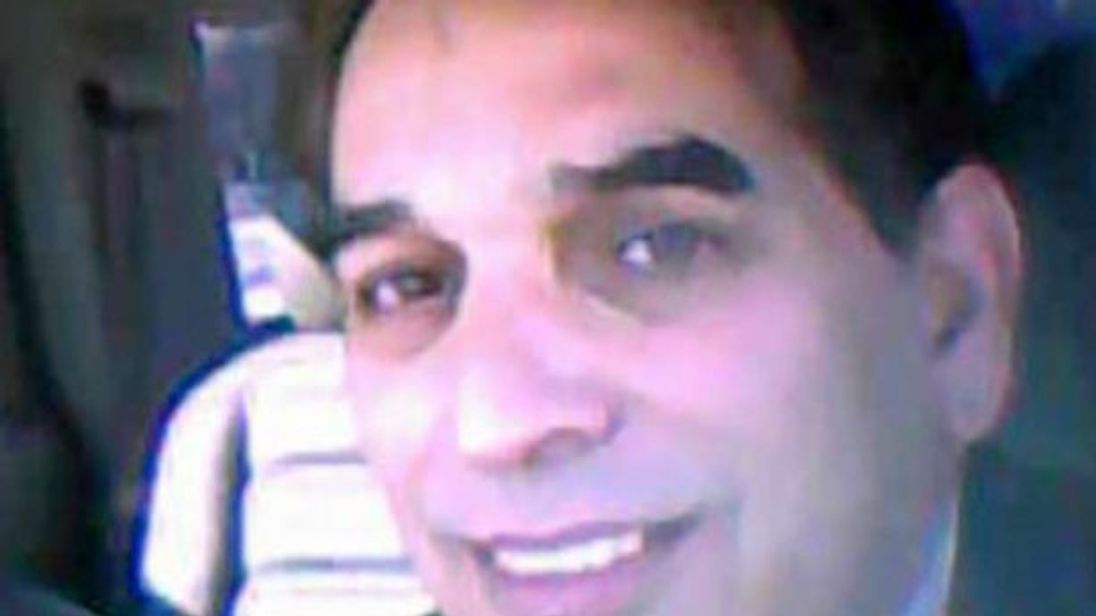
Image:Shahed Hussain, who owned the limousine company, was a paid FBI informant.The owner of a limousine company involved in a fatal crash was a paid government informant, it has emerged.
As the state of New York moved to shut down the company, Prestige Limousine, it emerged that its owner Shahed Hussain was an FBI informant who helped agents to investigate domestic terror threats.
Image:Eighteen people in the limousine were killed, as well as two pedestrians
Mr Hussain came to the US from Pakistan in the 1990s and settled in Albany where he was granted asylum along with his wife and two sons, according to evidence he gave in a previous trial.
In 2003, he was working as a government translator when he pleaded guilty to fraud after helping someone cheat on their driving test.
But he agreed to work as an FBI informant and served no jail time.
Image:Driver Scott Lisinicchia died in the crash, along with 19 other people
The 62-year-old helped authorities target an Albany pizza shop owner and an imam, both of whom were convicted of money laundering and conspiring to aid a terrorist group.
However, both men said Mr Hussain had tricked them.
In 2009, he was behind another sting that saw four men convicted of planning to bomb synagogues and shoot down planes.
This operation had focused on a Newburgh mosque where Mr Hussain posed as a wealthy representative of a terrorist organisation from Pakistan.
0:21
Video:Four sisters killed in limo were 'fun-loving'
The FBI supplied him with luxury vehicles to help him play the part.
Wearing a wire, he helped make tapes of the defendants choosing targets and ranting against Jewish people.
But defence lawyers said he was a master manipulator who entrapped a group of nobodies while earning $96,000 (£73,000).
US District Judge Colleen McMahon said at the time: "I believe beyond a shadow of a doubt that there would have been no crime here except the government instigated it, planned it and brought it to fruition.
"That does not mean there was no crime."
Albany-based lawyer Dana Salazar, who represented Mr Hussain in an unrelated civil case, confirmed to the Rochester Democrat & Chronicle on Monday that her client was the informant.
Image:The rape and murder of a Bulgarian journalist was an "execution" and meant as a warning, according to an investigative website.
Viktoria Marinova's body was found on Saturday in a park by the River Danube in the northern town of Ruse.
The 30-year-old victim, who had reported on an investigation into alleged corruption involving EU funds, suffered blows to the head and had been suffocated.
Ruse prosecutor Georgy Georgiev said her mobile phone, car keys, glasses and some of her clothes were missing.
The murder case has shocked fellow journalists and sparked international condemnation.
Image:Daphne Caruana Galizia was killed in Malta a year ago
Ms Marinova had presented a recently relaunched current affairs programme called Detector for the TVN television channel in Ruse.
The first episode, which aired on 30 September, had interviews with investigative journalists Dimitar Stoyanov from the Bivol.bg website and Attila Biro from the Romanian Rise Project.
It was about an investigation into alleged fraud involving EU funds linked to big businessmen and politicians.
Officials and the police said there was no evidence to suggest Ms Marinova's murder was related to her work and there was no information about her being threatened.
But Bivol.bg owner Asen Yordanov said he had received credible information his journalists were in danger of being assaulted because of the investigation that featured on Ms Marinova's show.
He said: "Viktoria's death, the brutal manner in which she was killed, is an execution. It was meant to serve as an example, something like a warning."
Image:Slovakian journalist Jan Kuciak was shot dead in February
TVN said: "With great pain and insurmountable grief the TVN's team is experiencing the loss of our beloved colleague Victoria Marinova and we pray for sympathy to the sorrow of her relatives and colleagues."
Harlem Desir, from the Organisation for Security and Co-operation in Europe, tweeted: "Shocked by horrific murder of investigative journalist Victoria Marinova in Bulgaria.
"Urgently call for a full and thorough investigation. Those responsible must be held to account."
Meanwhile, the Committee to Protect Journalists said it was "shocked by the barbaric murder", adding: "Bulgarian authorities must employ all efforts and resources to carry out an exhaustive inquiry and bring to justice those responsible."
Bulgarian Prime Minister Boyko Borisov said a large amount of evidence had been collected - including DNA - and warned "it is just a matter of time before the perpetrator is found".
Ms Marinova is the third European journalist to be killed in the past year.
Daphne Caruana Galizia, Malta's best-known investigative journalist, was killed in a car bombing last October.
Slovakian journalist Jan Kuciak was shot dead in February.
The full results of the Peoples Democratic Party (PDP)'s national convention which took place in Port Harcourt, Rivers state capital on Saturday, October 6, has been released.
Governor Dave Umahi of Ebonyi state read out the votes of 9 aspirants before Governor Ifeanyi Okowa of Delta announced the rest of the results. Saraki came third with 317 votes while Governor Aminu Tambuwal of Sokoto polled 693 votes.
Read the results below in tabular form:
A table showing the result of the PDP's national convention
Making his first speech after the announcement of his victory, Atiku, on his official Twitter page, expressed his immense gratitude to those who encouraged him in his presidential ambition by voting for him.
Meanwhile,Nigerians, especially on social media had reacted to Atiku's win.While most of his supporters congratulated him after the exercise, some of his detractors took to their Twitter handles to voice their displeasure over the outcome of the opposition's national convention.
President Okonkwo, a Nigerian Twitter user, has taken to social media to share the story of a yogurt man who received gain for all the effort of his hard-work. The man shared photos of the beautiful moment.
The Twitter user revealed that a yogurt vendor who has been in the business for 30 years in Kaduna received a sum of N3 million from a customer.
According to Okonkwo, the customer who gave out the money to the yogurt vendor was one of the the yogurt seller's customers when he was a kid.
Man who sold yogurt for 30 years in Kaduna receives N3m from one of his customers Photo: Twitter Source: President Okonkwo
President Okonkwo revealed that the yogurt vendor who use to give children yogurt for free when they couldn't afford it is reaping the gain of his good deed.
He also noted that the man was always nice to children. He wrote: "He sold yogurt for 30 years in Kaduna and was always nice to young children and gave them free yogurt when they had no money.
His good deeds came back haunting him when one of his child customers, now grown, surprised him with a 3 million Naira Cheque as appreciation."
The Nigeria Football Federation (NFF) have explained the rationale behind the exclusion of John Obi Mikel from the Super Eagles' squad that will face Libya this month in AFCON qualifiers.
Super Eagles gaffer Gernot Rohr made the list available on Monday in which Mikel Obi's name was not included and many Nigerians have been reacting.
Mikel has not played for Nigeria since the end of the 2018 FIFA World Cup in Russia where Eagles were bundled out of the competition after losing their last Group game against Argentina.
"Obi Mikel has been excused because he is just recovering from injury in China and needs time to fully regain fitness."We expect him to be available for the November game against South Africa,'' Super Eagles spokesman Toyin Ibitoye told BBC.
Meanwhile, Libya are currently topping Group E in 2019 AFCON qualifiers with four points followed by South Africa on the same point. Nigeria are third on the log with three points.
Nigeria lost their first game at home against South Africa, but they redeemed themselves in their second game against Seychelles getting the three points.
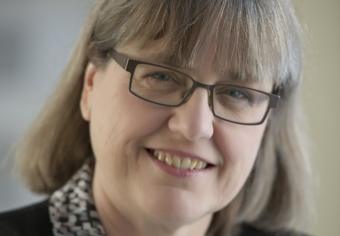
Image copyrightUNImage captionDr Strickland shared the prize for discoveries in laser physics
The 2018 Nobel Prize in Physics has been awarded to a woman for the first time in 55 years.
Donna Strickland, from Canada, is only the third woman winner of the award, along with Marie Curie, who won in 1903, and Maria Goeppert-Mayer, who was awarded the prize in 1963.
Dr Strickland shares this year's prize with Arthur Ashkin, from the US, and Gerard Mourou, from France.
It recognises their discoveries in the field of laser physics.
Dr Ashkin developed a laser technique described as optical tweezers, which is used to study biological systems.
Drs Mourou and Strickland paved the way for the shortest and most intense laser pulses ever created.
The last woman to win the physics prize, German-born American physicist Maria Goeppert-Mayer, took the prize for her discoveries about the nuclei of atoms.
Polish-born physicist Marie Curie shared the 1903 award with her husband Pierre Curie and Antoine Henri Becquerel for their research into radioactivity.
The award is worth a total of nine million Swedish kronor (£770,686; $998,618).
Reacting to her win, Dr Strickland, who is based at the University of Waterloo in Canada, said: "First of all you have to think it's crazy, so that was my first thought. And you do always wonder if it's real.
"As far as sharing it with Gerard, of course he was my supervisor and mentor and he has taken CPA (Chirped Pulse Amplification) to great heights so he definitely deserves this award. And I'm so happy Art Ashkin also won."
She added: "I think that he made so many discoveries early on that other people have done great things with that it's fantastic that he is finally recognised."
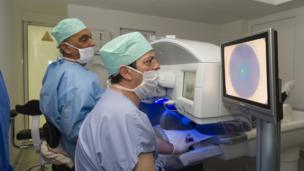
Image copyrightSPLImage captionMourou and Strickland's technique has found several applications, including in laser eye surgery
Before Strickland and Mourou's pioneering work, the peak power of laser pulses was limited because, when cranked up to high intensities, they would destroy the material used for amplifying its energy.
To get round this, the researchers first stretched the laser pulses in time to reduce their peak power, then amplified them and finally compressed them.
When a laser pulse is compressed in time and becomes shorter, more light is packed into a small space. This dramatically increases the intensity of the pulse.
Strickland and Mourou's technique, called chirped pulse amplification (CPA), became standard for high intensity lasers. It also found a use in laser therapy targeting cancer and in the millions of corrective laser eye surgeries which are performed each year.
Arthur Ashkin realised an old dream in science fiction - using the radiation pressure of light to move physical objects. In doing so, he invented the optical tweezers that are today used to grab particles, atoms, viruses and living cells with their laser-based pincers.
Ashkin first worked on getting laser light to push small particles towards the centre of the beam and hold them there.
Then, in 1987, he used the tweezers to capture living bacteria without harming them. The technique is now used widely to study the machinery of life.
In a statement, the American Institute of Physics (AIP) offered its congratulations to all the winners, adding: "The countless applications made possible by their work, like laser eye surgery, high-power pettawat lasers, and the ability to trap and study individual viruses and bacteria, only promise to increase going forward.
"It is also a personal delight to see Dr Strickland break the 55-year hiatus since a woman has been awarded the Nobel Prize in Physics, making this year's award all the more historic."
Previous winners of the Nobel Prize in Physics
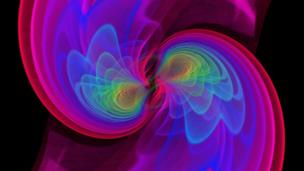
Image copyrightS.OSSOKINE/A.BUONANNO (MPI GRAVITATIONAL PHYSICS)Image captionA computer simulation of gravitational waves radiating from two merging black holes