The Senate president, Bukola Saraki, today Monday, December 17, approved the names of 12 nominees into the National Assembly Service Commission (NASC).
The appointees include:
1. Senator Joy Emordi (Anambra) who is being proposed as the chairman,
2. Nuhu Musa (Jigawa),
3. Hon Bilyaminu Yusuf Shinkafi (Kebbi),
4. Barrister Femi Agge (Edo),
5. Uthman Olakunle Taofeek (Lagos),
6. Prince Adenekan Olateru-Olagbegi (Ondo),
7. Abdulazeez Sheikh Usman (Kwara),
8. Awalu Aliyu Ohindese (Kogi),
9. Henry Odey Adagba (Ebonyi),
10.Dr. Rufus Omeire (Imo),
11. Hon. Bilyamini Bunbot (Bauchi),
12. Ahmed Ashemi (Borno).
The Senate stated that in line with the provisions of sections 3 and 4 of the National Assembly commission act, 2000, the names of the nominees will be presented to President Muhammadu Buhari for appointment.
The workers stormed the entrances to the National Assembly complex in the early hours of Monday, December 17, to barricade the gates and prevent entry.
Our source gathered that more security operatives have been deploy to manage the protesters.
The management of Diamond Bank on Monday, December 17, announced its merger with Access Bank.
Statement by Uzoma Uja, the bank’s secretary/legal adviser, said the transaction will be completed by the first half of 2019.
“The proposed merger would involve Access Bank acquiring the entire issued share capital of Diamond Bank in exchange for a combination of cash and shares in Access Bank via a Scheme of Merger,” the disclosure, sent to the Nigeria Stock Exchange, said.
Read the full statement below:
Statement regarding scheme to merge with Acess Bank
"The Board of Diamond Bank Plc (“Diamond Bank”) today announces that following a strategic review leading to a competitive process, the Board has selected Access Bank Plc (“Access Bank”) as the preferred bidder with respect to a potential merger of the two banks (“the merger”) that will create Nigeria and Africa’s largest retail bank by customerTheThe Board of Diamond Bank believes that the merger is in the best interest of all stakeholders including, employees, customers, depositors and shareholders and has agreed to recommend the offer to Diamond Bank’s shareholders. Completion of the merger is subject to certain shareholder and regulatory approvals.
"The proposed merger would involve Access Bank acquiring the entire issued share capital of Diamond Bank in exchange for a combination of cash and shares in Access Bank via a Scheme ofMerger. Based on the agreement reached by the Boards of the two financial institutions, Diamond Bank shareholders will receive a consideration of N3.13 per share, comprising of N1.00 per share in cash and the allotment of two (2) New Access Bank ordinary shares for every seven (7) Diamond Bank ordinary shares held as at the
"Implementation Date. The offer represents a premium of 260% to the closing market price of N0.87 per share of Diamond Bank on the Nigerian Stock Exchange (“NSE”) as of December 13, 2018, the date of the final binding offer.
"Immediately following completion of the merger, Diamond Bank would be absorbed into Access Bank and it will cease to exist under Nigerian law. The current listing of Diamond Bank’s shares on the NSE and the listing of Diamond Bank’s global depositary receipts on the London Stock Exchange will be cancelled, upon the merger becoming effective."
Diamond Bank expects the transaction to be completed in the first half of 2019.
The figure represents an average of $86,000 debt owed per person, according to a statement by Ting Yan, a press officer at IMF, on Global Debt Database (GDD) update.
Yan said: “Today, the International Monetary Fund updated its publicly available Global Debt Database (GDD) – a comprehensive dataset covering public and private debt for virtually the entire world (190 countries) dating back to the 1950s.
“Today’s update of the GDD offers for the first time a glimpse of global debt developments up to 2017.
“By including both the sovereign and private sides of borrowing for the entire world, the GDD offers an unprecedented picture of global debt in the post-World War II era.” Like to place ur adverts here call
President Muhammadu Buhari on Sunday, December 9, revealed what he called the 'ABC of fighting corruption', during the launch of the Africa Youth Congress Against Corruption (AYCAC 2018) at the State House, Abuja.
The event coincided with the International Anti-Corruption Day.
The president has made the fight against sleaze a key point of his administration’s agenda and this resulted in his naming as champion of the African Union (AU) theme of the year – “Winning the fight against corruption: A sustainable path to Africa’s transformation” in January this year in Addis Ababa, the Ethiopian capital.
In his address, the president said: “Let me share with you what I believe are the A, B, C of fighting corruption:“ A” stands for Action. Let us all move from talk to action. I urge you to develop tangible projects in your communities to instill transparency and accountability of the highest standards.
“B” stands for Building Bridges. The youths have a unique opportunity to spearhead the building of inter-generational and cross-sectoral bridges in our various communities. Often, fighting corruption requires partnerships with unlikely allies. Be open to exploring constructive partnerships with a wide base of actors.
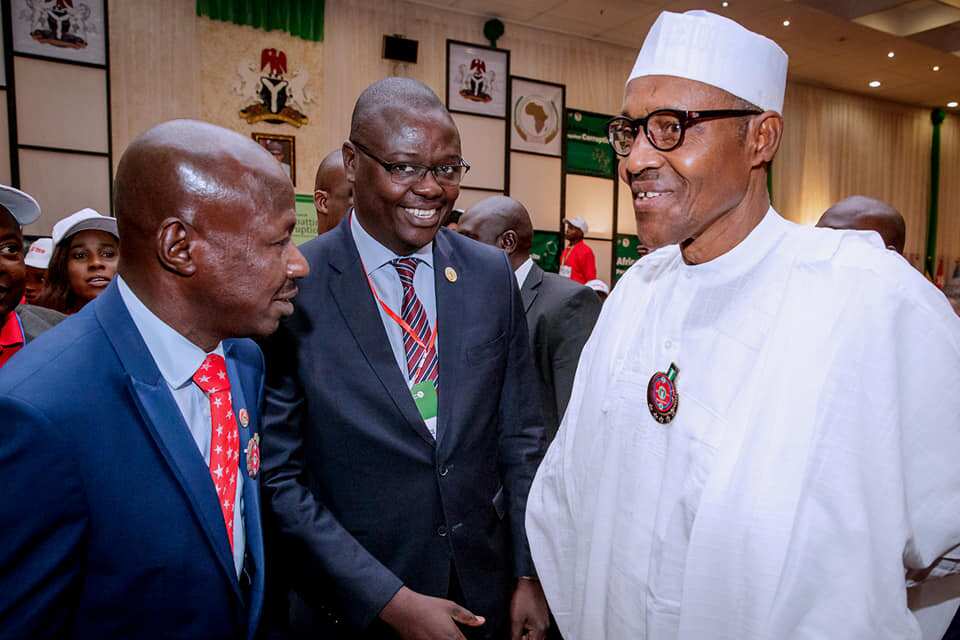
President Muhammadu Buhari discussing with EFCC chairman, Ibrahim Magu, during the unveiling of ABC of anti-corruption fight in Abuja. Credit: Femi Adesina
“C” stands for Culture. So, let us cultivate and equip ourselves with African culture, right attitude and mindset change that will enable us to stand firmly against corruption. By so doing, accountability and change will begin with you and me.”
Appreciating continental leaders, Buhari noted: “The anti-corruption year of the African Union has been long and demanding. The year has also been filled with sharing of great lessons, promises and inspirations as well as some success stories on our journey to winning the fight against the evil of corruption.”
He further stated: “To the young people of Africa, this fight against corruption is yours to lead and to win in order to reverse the negative trends of corruption and its implications for Africa.
“The youths must pool their energies to effectively ensure that our natural and mineral resources remain on the continent for value addition, job and wealth creation as well as to create affordable health-care and quality education for our people. Winning the fight against corruption is very much in your hands.”
In his remarks, the acting chairman of the Economic and Financial Crimes Commission (EFCC), Ibrahim Magu, regretted the rampant nature of the malaise on the continent, urging action to stem the tide.
He said since Buhari was nominated as Africa’s chief anti-graft czar, the president had displayed and would continue to exhibit his aversion to the sordid trend in Nigeria.
To take the crusade to the next level, Magu stated that the support of youth was critical.
Meanwhile, the president will today, Monday, December 10, present a report of the nation’s corruption risk assessment on e-Government systems.
The acting chairman of the Independent Corrupt Practices and other related Offences Commission (ICPC), Musa Usman Abubakar, made the disclosure during a press briefing at the weekend in Abuja.
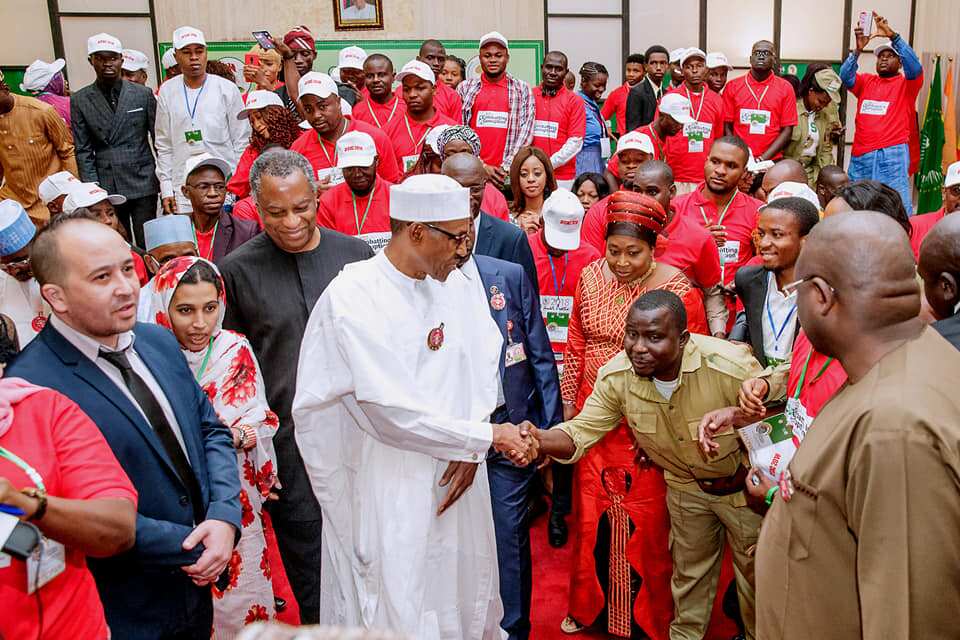
President Muhammadu Buhari acknowledging cheers from the participants during the unveiling of ABC of anti-corruption fight in Abuja. Credit: Femi Adesina
He explained that the document was a product of the commission to safeguard the payment system from sleaze.
Meanwhile President Muhammadu Buhari congratulated former chairman of the Economic and Financial Crimes Commission (EFCC), Nuhu Ribadu, for winning the Anti-Corruption Lifetime Achievement Award.
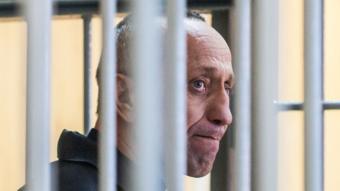
Image copyrightAFPImage captionPopkov in court in Irkutsk: he left the police force in 1998
A Siberian policeman described as Russia's most prolific mass murderer in modern times has been given a second life sentence.
Mikhail Popkov, 53, murdered 55 women and a policeman near Irkutsk. He was already in jail for 22 other murders.
He hacked women to death after offering them rides in his car late at night. At least 10 were also raped. In three cases he was on duty in his police car.
Popkov was caught in 2012 after a DNA match identified his car.
The victims were all women between the ages of 16 and 40 apart from one male, a policeman. The killings took place between 1992 and 2007.
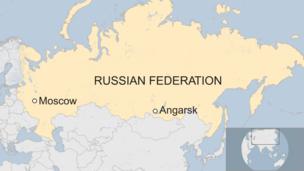
Popkov killed them around the city of Angarsk, near Irkutsk, with an axe and hammer. He dumped their mutilated bodies in forests, by the roadside and in a local cemetery.
The death toll exceeds the 48 murdered by "chessboard killer" Alexander Pichushkin, and the 52 murdered by Andrei Chikatilo during the Soviet era.
Popkov claimed to be "purging" Angarsk of what he saw as immoral women.
Tyre marks from Popkov's Niva car were found next to some of the bodies, which led police to check all owners of that Niva type in Angarsk.
The owners' DNA was checked against DNA found on the victims, and that enabled police to identify Popkov. He was arrested in Vladivostok, in the far east, where he had gone to buy a new car.
An Irkutsk court found him guilty of 22 murders in 2015 and sentenced him to life, but he
Vice President Yemi Osinbajo has arrived Berlin, Germany, and is now holding a town hall meeting with the Nigerian community in that country.
Oue source gathers that the disclosure was made by Laolu Akande, the senior special assistant on media and publicity to the vice president.
Akande, who took to his official Twitter page to make the disclosure, said about 30 questions had already been tabled as VP began to interact with the people of Nigeria.
He tweeted: "VP Osinbajo arrives in Berlin and is now holding a townhall meeting with the Nigerian community in Germany. About 30 questions tabled already as VP begins to interact with the people."
VP Osinbajo arrives in Berlin and is now holding a townhall meeting with the Nigerian community in Germany. About 30 questions tabled already as VP begins to interact with the people
In a statement in Abuja, Laolu Akande, the senior special assistant on media and publicity to the the vice president, said that Osinbajo would speak on the potential of the Nigerian market.
He said that Osinbajo would also speak on the gains recorded by the country through its Ease of Doing Business reforms.
“The President Muhammadu Buhari administration’s Ease of Doing Business reforms have helped in improving the country’s ranking in the World Bank’s Doing Business Index 2017, where Nigeria climbed up 24 places and was listed among the 10 most reformed economies globally.
“Also, the World Bank noted that Nigeria made significant progress across several indicators; including starting a business, dealing with construction permits, getting electricity, registering property, getting credit, protecting minority investors, paying taxes, trading across borders, enforcing contracts, and resolving insolvency.
He said: “The Berlin business interactions with vice-president is being organised by the Nigerian Embassy in Berlin in conjunction with the German-African Business Association (Afrika-Verein), and the meetings will consolidate on the outcome of the German Chancellor, Angela Merkel’s visit to Nigeria in August."
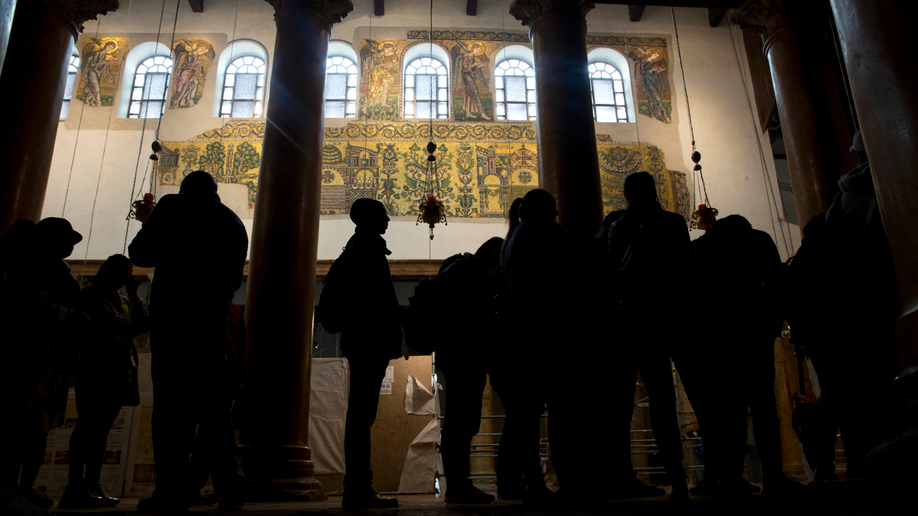
In this Thursday, Dec. 6, 2018 photo, visitors stand bellow a renovated part of a fresco inside the Church of the Nativity, built atop the site where Christians believe Jesus Christ was born, in the West Bank City of Bethlehem. City officials are optimistic that the renovated church will help add to a recent tourism boom and give a boost to the shrinking local Christian population. (AP Photo/Majdi Mohammed)
BETHLEHEM, West Bank – A historic renovation of the Church of the Nativity is lifting spirits in the biblical town of Bethlehem ahead of Christmas, offering visitors a look at ancient mosaics and columns that have been restored to their original glory for the first time in 600 years.
City officials hope the renovation at the traditional birthplace of Jesus will boost tourism and a weak economy in the Israeli-occupied West Bank, and perhaps slow a decades-long drain of the Christian population from the lands where the faith was born.
"Christians are leaving the Holy Land due to the lack of peace and economic hardships and we are struggling to keep them in their homeland," said Bethlehem Mayor Anton Salman. "This is one of the ways."
The renovation started in 2013, a year after UNESCO declared the church a world heritage site, and is expected to be completed by the end of next year. The Palestinian Authority formed a committee of local Christian leaders to oversee the renovation and contracted an Italian company to carry out the project.
Ziad al-Bandak, the committee head, said it has collected $14 million out of $17 million needed. Roughly half of the funding has come from the Palestinian Authority and local Muslim and Christian businesses, and the rest from foreign donors.
lt has become such a beautiful church," he said. "Every Christian in the world would love to see it now."
One of Christianity's most sacred shrines, the church was built in the 4th century by Saint Helena over a cave where the Virgin Mary is said to have given birth. What pilgrims mostly see today is the basilica built by Byzantine Emperor Justinian 1,who ruled from A.D. 527 to 565.
Neglected for decades before the renovation, the roof of the church was leaking, windows were broken, mosaics were covered in grime and walls and columns were damaged.
After five years of work, it has been transformed.
Emad Nassar, a Palestinian engineer overseeing the renovations, said the project started with the ceiling. Roughly 10 percent of the beams were replaced with wood imported from old destroyed churches in Italy, windows were fixed, and outside stones and walls were renovated.
Perhaps the biggest challenge has been repairing the badly damaged 2,000 square meter (21,500 square foot) wall mosaic. So far, 120 square meters (1,292 square feet) have been restored, depicting images of Christ and Christian saints. Workers are also restoring a floor mosaic.
The restoration process is meticulous and painstaking. As Nassar spoke, three Italian workers were cleaning a mosaic with tiny brushes and covering them with protective material.
"In the coming year, we are going to continue renovating the columns, the floor mosaic, the tiles and the front yard floor," Nassar said.
The delicate relations between the Holy Land's major Christian denominations have factored into the poor condition of the church. The Roman Catholic, Greek Orthodox and Armenian churches have traditionally viewed each other with deep suspicion.
Under a 19th-century agreement called the Status Quo, each denomination has its own areas and responsibilities. But over the years, turf battles have erupted into arguments and even fistfights among clergymen.
Father Samour, a 70-year-old Greek Orthodox clergyman who has served at the church for nearly half a century, said the Palestinian Authority managed to get the rival churches on board.
The construction did not touch the altar crypt with the 14-point silver star marking the spot where, according to Christian tradition, Jesus was born. Although it also needs renovation, the churches have not yet reached an agreement on the crypt.
Bethlehem is heavily dependent on Christmas tourism, with hotels, restaurants and gift stores doing much of their business during the short holiday season. The renovated church has become a popular destination.
"The mosaic on the walls is very beautiful, and the renovation is very impressive," said Sandris Gradins, a 31-year-old tourist from Latvia.
After dipping in 2015 and 2016, tourism has seen a comeback in the past two years, officials say. The mayor said he expects 1.2 million visitors this year.
Tourism Minister Rula Maayah said she is working with Christian officials to expand visiting hours to accommodate the long lines.
An ambitious program has been set up for Christmas this year, she said. The municipality recently hosted representatives of 14 twin cities from around the world for a Christmas tree lighting ceremony. Foreign musicians performed Christmas songs during the event.
Fifteen European countries participated in a Christmas market in the front yard of the church. The municipality also has been building a Christmas village for children.
But whether the city's efforts can stop the long-term outflow of Bethlehem's Christians remains to be seen. As elsewhere in the Arab world, the local Christian community has struggled for decades, escaping conflict and economic troubles in search of better opportunities abroad.
In the Holy Land, Israel's half-century-old occupation of the West Bank and east Jerusalem, and more than a decade of rule by the Islamic militant group Hamas in Gaza have significantly worsened the situation.
A 2017 census in the West Bank, Gaza and east Jerusalem counted just under 47,000 Palestinian Christians, or about 1 percent of a Palestinian population of close to 4.8 million. Twenty years earlier, Christians still made up more than 1.7 percent of the Palestinian population, according to the Palestinian Central Bureau of Statistics.
Roughly half of Palestinian Christians live in the Bethlehem area, where their share of the population has also declined significantly.
Wadie Abunassar, a senior adviser to church leaders in the Holy Land, said the Palestinian leadership in the West Bank has treated Christians well, but that lack of progress toward a resolution with Israel and Palestinian statehood have driven emigration.
Despite lack of hope, he urged Christians to stay.
"This is our homeland. We are called to be witnesses for Jesus in his homeland," he said. "This is a great privilege, which most Christians in the world don't have."
Emerging reports have claimed that the former Oyo state governor, Rashidi Ladoja, on Tuesday, November 27, appeared at the Federal High Court, Lagos over alleged money laundering.
Channel TV reports that Ladoja is standing trial on an eight count charge alongside Waheed Akanbi, who served under him as the state commissioner for finance.
In the charges, Ladoja and Akanbi were accused of converting a sum of N1,932,940,032.48 belonging to the state to their personal own, using a bank account of a company, Heritage Apartments Limited.
The Economic and Financial Crimes Commission (EFCC) claimed that they retained the money sometime in 2007, despite their knowledge that it was proceeds of a criminal conduct.
In another instance, Ladoja was accused of removing a sum of £600,000 from the state coffers in 2007 and sent it to Bimpe Ladoja, who was at the time in London.
He was also accused of converting a sum of N42m belonging to the state to his own and subsequently used it to purchase an armoured Land Cruiser jeep.
The former governor was also accused of converting a sum of N728,600,000 and another N77,850,000 at separate times in 2007 to his own.
The commission noted that Ladoja transferred the N77, 850,000 to one Bistrum Investments, which he nominated to help him purchase a property named Quarter 361, Ibadan, Oyo State.
The EFCC told the court that Ladoja and Akanbi acted contrary to sections 17(a) and18 (1) of the Money Laundering (Prohibition) Act, 2004 and were liable to be punished under sections 14(1), 16(a) (b) and 18(2) of the same Act.
Justice Rakiya Haastrup dismissed the suit on Wednesday, June 20, on the grounds that it was statute barred. The suit is statute barred, it means it is no longer legally enforceable because the prescribed period for legal action had elapsed.
You like to Place your adverts here call 08169603984.
The confirmation of Olanipekun Olukoyede as secretary of the Economic and Financial Crimes Commission (EFCC) has been suspended by the Senate.
A member of the Senate committee on anti-corruption and financial crimes, Isa Misau had earlier accused the committee of preparing a report without the consent of others,
Our source gathers that the lawmaker complained that the endorsement page report was signed by only three out of eight members of the committee.
He said: “Let’s step down this report so that we, the members of the committee can go through it. Because I participated actively in the screening of these nominees and there are some of them that are not competent to hold that office.
“I’m just seeing this report. It has not been sent to my office and I was part of the screening and during the screening, I made objections on certain people that are not supposed to hold that office to be screened. It is necessary for us to look at the report."
The chairman of the committee, Chukwuka Utazi, who urged the Senate to confirm Olukoyede, said: “Most of the committee members are busy with oversight. We wrote every member to be in attendance. What Misau attended was the ICPC screening. He attended and participated but he did not attend this one.
“We gave the notice to everybody to attend; and at the end of the day, the number of people who attended, formed quorum and took the decision on behalf of the committee (signed)."
Utazi was thereafter asked by the Senate president, Bukola Saraki, to meet with his members later in the day, conclude and re-present the report on Wednesday, November 28.
President Muhammadu Buhari nominated Olanipekun Olukoyede, the chief of staff to the chairman of the Economic and Financial Crimes Commission (EFCC), Ibrahim Magu, as the secretary of the commission.
The president in a letter to the Senate requested that Olukoyede's nomination be confirmed as secretary of the EFCC.
The letter dated September 10, 2018, and addressed to Senate president, Bukola Saraki, asked that Olukoyede be confirmed in accordance with Section 2 of the EFCC Act.