Pages

Wednesday, 7 February 2018

2019: INEC may use satellite to transmit results electronically

The Independent National Electoral Commission (INEC) has disclosed that the results of the 2019 general elections will be transmitted electronically, via the Nigerian Communications Satellite Limited (NIGCOMSAT).
According to a reliable source the development was made public by Professor Mahmood Yakubu, the INEC chairman, during a working visit to the NIGCOMSAT headquarters in Abuja, the nation’s capital, on Wednesday, February 7.
Our source gathers that immediately after counting at polling units, INEC plans to use the NIGCOMSAT Sat 1-R satellite to transmit the results electronically.
The INEC boss stated that the commission was committed to deepening the deployment of technology in elections; and expressed satisfaction with what he saw at the satellite communication agency.
According to Yakubu, the results of elections of each of the 119, 973 polling units across the country and the scanned image of result sheets would be electronically transmitted on the spot and in real time.
He also implored NIGCOMSAT to use electronic message display to aid with voter education as the elections draw near.
He stated: “It is for this reason that we wish to leverage on the capacity of NIGCOMSAT to provide a wide range of telecommunication services.
“In particular, your broadband service offers a tremendous flexible bandwidth capacity that can be deployed almost anywhere and in a short period of time, including hard-to-reach and temporary locations.
Already the Independent National Electoral Commission (INEC) said it would announce the 2019 election results electronically in addition to issuing physical copies of results to party agents.
The electoral body, therefore, called on telecoms service providers to assist the commission.
Prof Mahmood Yakubu said this when he visited the executive vice-chairman of the Nigerian Communications Commission (NCC), Professor Umar Danbatta, in Abuja.

Eyube urges Nigerians not to react negatively to the letters from Obj.IBB.

A chieftain of All Progressives Congress (APC) in Delta state, Kennedy Eyube, has reportedly said the 2019 re-election moves of President Muhammadu Buhari have been boosted by the separate open letters from Chief Olusegun Obasanjo and Ibrahim Babangida. 
Eyube saying in a statement in Warri, Delta state, that Nigerians should avoid criticizing Obasanjo and Babangida or react negatively as the letters should be seen as a major boost for the president’s re-election bid.
“Both Chief Obasanjo and General Babangida ruled this country for eight years each or more. Their governments were not entirely perfect.
“Nigerians still have records of how they ruled this country, so, they should allow President Buhari to do his eight years after which Nigerians can also pass judgment on Buhari’s tenure.
“If Obasanjo and IBB couldn’t permanently solve the problems of Nigeria when they had the opportunity to do so while in power, the right thing for Obasanjo and IBB to do now is to support Buhari to repair this country and correct some of the mistakes made and things they left undone years ago,”he said.
He further argued that another term for Buhari would create a better road-map and foundation for the progress of Nigeria.
Earlier a chieftain of the All Progressives Congress (APC) in Niger state, Jonathan Vatsa, reportedly warned President Muhammadu Buhari to immediately listen to calls by well-meaning Nigerians and sack the alleged cabal surrounding him.
Vatsa, a former information and culture commissioner in the state, said this must be done urgently before it becomes late.

My letter to the president was to advise him- Obasanjo

Former president, Chief Olusegun Obasanjo has said that the forward for the country was for youths and women to be put in positions were they can contribute to national development.
The Nation reports that the former president spoke at his Olusegun Obasanjo Presidential Library in Ogun state when a youth group from Delta State led a governorship aspirant, Frank Ufuoma Esanubi, to pay him a courtesy visit.
Obasanjo said he is focused on Nigeria’s future but clarified that he does not have a preferred candidate for 2019.
He said his Coalition for Nigeria Movement is geared towards galvanising a paradigm shift noting that people at the grassroot have been ignored by the government.
Obasanjo said his letter to President Muhammadu Buhari was not to belittle the positon or embarrass him but to offer advice.
He said: “In the year 2015, I said I would no longer participate in partisan politics. And I still stand by my decision. Everybody, irrespective of his or her political affiliation is free to come here for advice, I will gladly do that. I have no candidate, whatsoever, for any political office. I just believe that things must be done differently in Nigeria to get different result.
“If you study our transitions since the colonial era, they have all taken place without taking the people of the grassroots into consideration. So, CNM is about the people at the grassroots. It is a socio-economic movement where youth and women, especially, will be given opportunity to appreciate their interests and power. Unlike before, I believe we must put the horse before the cart.
“If the system and the platform sync, I believe Nigeria will get there. And like I said, the moment the Coalition gets involved in candidate sponsoring or participates in partisan politics, I will opt out of it.”

43-year-old Nigerian woman stuck in UK with N251m hospital bill after delivering quadruplets

According to DailymailUK, Priscilla gave birth to quadruplets prematurely in Britain and she has a bill of £500,000 ( N251.5m ) in one of the largest hospitals. According to her, even if she's working everyday, she won't be able to pay up the debts singlehandedly.
The 43-year-old healthcare worker had planned to give birth to her babies in Chicago, in the US, where she has a family. But she was turned away by border officials on arrival, saying although she had a visa, she did not have required documents from a hospital stating that she can pay for birth charges.
Story of a 43-year-old Nigerian woman stuck in UK with N251.5 million hospital bill
Priscilla, pictured, said she 'would never earn' enough to pay the bill for her treatment ked every day in her life'
She was on her way back to Nigeria when she started having contractions. She went into labour three months early shortly after landing at Heathrow airport in November. She was rushed to the Queen Charlotte’s and Chelsea Hospital in west London, part of Imperial College Hospital, where she delivered the four babies.
One of the babies died immediately after birth while another, a girl named Deborah, passed away on Saturday. The other two, Elijah and Esther, are still being treated on the hospital’s neonatal intensive care ward.
Story of a 43-year-old Nigerian woman stuck in UK with N251.5 million hospital bill
Talking about her bill on the documentary, Priscilla, pictured, said 'It's only money. Money can't buy life'
Staff estimate that the total bill for the highly complex birth and the care of the babies is already more than £500,000. The cost of treating one baby in neonatal intensive care is £20,000 a week. Priscilla is currently staying at a hostel run by a charity and is unable to afford the bill.
Priscilla's husband is in Nigeria. He is not planning to travel to meet her because he does not have money for a visa or the flight. Priscilla underwent IVF treatment, which has a high risk of multiple births, as she was struggling to conceive naturally due to her age.
She was told by her doctor to fly to the US to have her babies, as Nigerian hospitals do not have the ‘facilities to cater for the children’. Her case was revealed on BBC 2 documentary Hospital, which exposes the pressures of health tourism on the trust.
When Priscilla was first warned of the high cost of treatment by overseas visitor manager Terry Facey, she said:
‘I didn’t plan to come here. ‘It’s only money. Money can’t buy life. The last bill I had was £331,000 but even if I worked every day I would never earn that much money. My kids are priceless.’

Fuels scarcity: Dogara suggests permanent solution

The Speaker of the House of Representatives, Yakubu Dogara, has said that refining crude oil locally would be a permanent solution to ending fuel scarcity in Nigeria.
Dogara said local refining of crude will make fuel easily accessible to all Nigerians.
Speaking while receiving members of the petroleum and Natural Gas Senior Staff Association of Nigeria (PENGASSAN) at the National Assembly on Tuesday, February 6, Dogara said a high-powered consultation is ongoing on the part of leadership at different level.
He said Nigeria will continue getting temporary result until local refining of crude is commenced.
He also called for capacity building for workers to discharge the responsibility to yield optimal results.
Dogara said: "Unless we are able to refine crude locally, we will never be in a position as a nation to say bye to fuel scarcity and that is the truth. Anyone who thinks we can depend on importation and still solve this problem is deceiving himself.
"You see, when you import, you are depending on so many variables. These variables are not within your control and anything can happen along the line that may result in this. The solution is to refine crude locally and end this shame once and for all.
"The final solution will be to refine this crude, put it in the filing station and say bye to fuel scarcity," Dogara said.
He also commended the leadership of PENGASSAN for taking the right path by engaging with legislators on areas of concern on developments in the petroleum sector.
He promised that the National Assembly is working on the remaining components of the Petroleum Industry Bill to ensure that their passage are expedited.
Also speaking, the president of PENGASSAN, Francis Johnson, commended the House for its effort in ensuring accountability and transparency in the oil and gas industry.
Johnson while commending the National Assembly for passing the PIGB said the fuel scarcity Nigerians are experiencing is embarrassing.
He urged the House to collaborate with PENGASSAN on finding a sustainable way to end the crisis and prevent a resurgence by revamping and rehabilitating the nation's refineries with timelines and strategies that will lead to adequate and sustainable crude supply.

2019: Senate, Reps finally adopt reordered sequence of election

The National Assembly conference committee on electoral act (amendment) bill on Tuesday, February 6, adopted the reordered sequence of the 2019 general elections, making presidential election last.
The News Agency of Nigeria reports that the House of Representatives had few weeks ago, began process to amend the electoral act 2010 with the inclusion of section 25(1) in the law.
Our source gathered that this was to reorder the sequence of the elections, to commence with National Assembly, followed by governorship and state House of assembly, and presidential as last.
This is against the sequence rolled out by Independent National Electoral Commission (INEC) late 2017, which put presidential and National Assembly elections first and governorship and state assembly to follow.
The chairman of Senate committee on INEC, Suleiman Nazif, said that the bill did not in any way violate any provisions of Section 76 of the 1999 Constitution which empowered INEC to fix dates and conduct elections.
He said the words “empowering INEC’’ to that effect were duplicated in the bill just as powers conferred on the National assembly by section 4 (2) of the Constitution were exercised in relation to rescheduling of elections.
Nazif said that inclusion of section 25(1) which changed the sequence of election different from the one earlier released by INEC had not violated any provisions of the laws governing the operations of the electoral body.
In his contribution, chairman, House of Representatives committee on INEC, Edward Pwajok, said that what the House concurred with the Senate as was very necessary in giving credibility to the electoral process.
“The sequence of election provision in the bill is not targeted at anybody but aimed at giving credibility to the electoral process.
“This is by giving the electorate the opportunity to vote based on qualities of candidates vying for National Assembly seat,” he said.
Pwajok added that if the bill was given assent by the president, the lawmakers, who based on national interest, adopted it, would invoke constitutional provisions at their disposal to make it see the light of the day.
“Whether it would be assented to or not by the President, as far as we are concerned, remains in the realm of conjuncture for now but if such eventually happens, we will know how to cross the bridge,” he said.
A member of the committee, Dino Melaye (APC-Kogi), said that while date for election was the prerogative of INEC, extant laws gave schedules for such elections as sole responsibility of the National Assembly.
“So contrary to reports and comments by some Nigerians on the reordered sequence of election, National Assembly has not overlapped its boundaries,” he said. (NAN)
 Previously  opposition parties numbering over 30 under the auspices of coalition for a New Nigeria on Wednesday, January 31, after a leadership meeting in Abuja called for a review of the 2019 general elections time table.

Tuesday, 6 February 2018

SpaceX successfully launches Falcon Heavy rocket


spacex falcon rocket
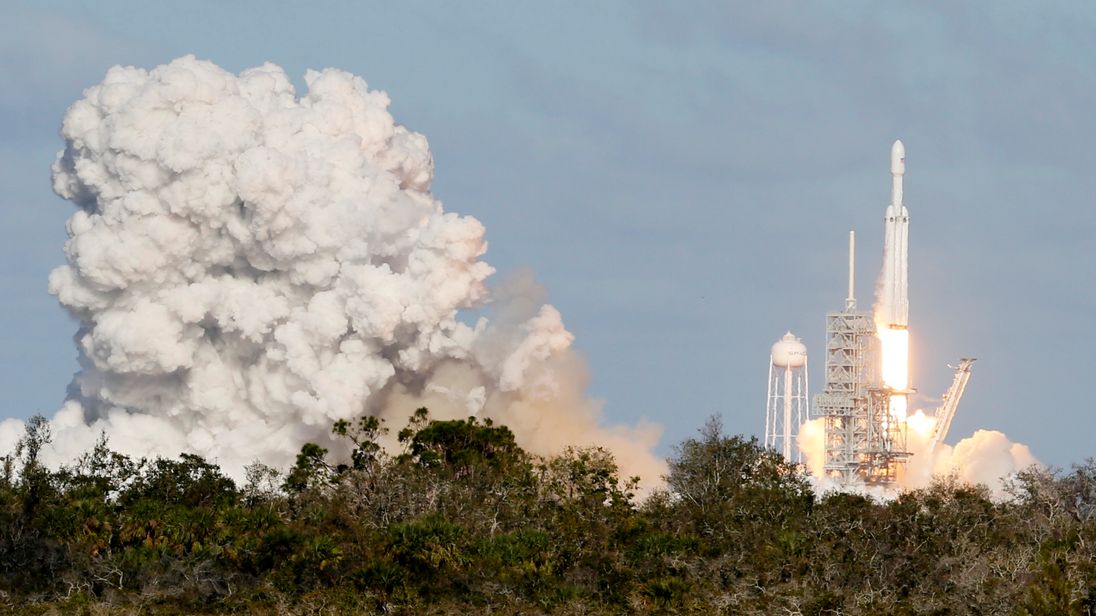
Image:The rocket blasted off from Florida's Cape CanaveralThe world's most powerful rocket has blasted off from Cape Canaveral, sending a car into an orbit that could last a billion years.
Space X's Falcon Heavy rocket fired up its 27 engines and three boosters and lifted off to raucous cheers and applause at 3.45pm local time.
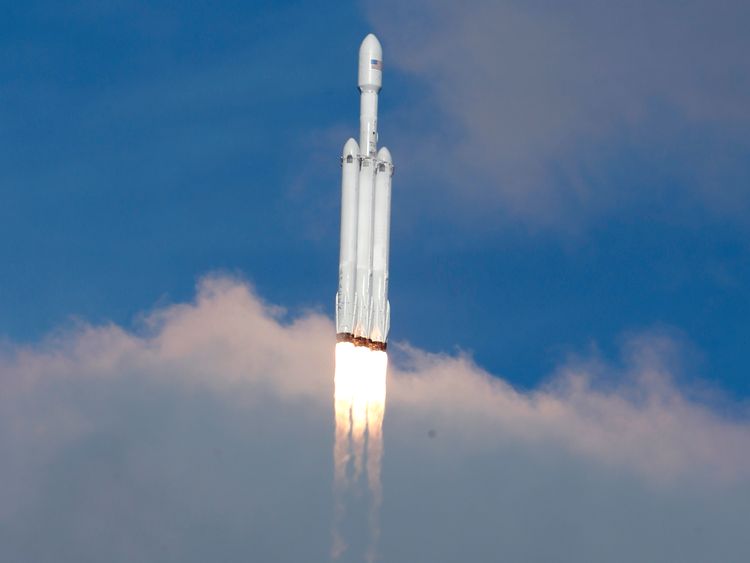
Its five million pounds of thrust, equal to the power of 18 jumbo jets, appeared to work without a hitch as the rocket sped into the Florida sky on its first test mission.
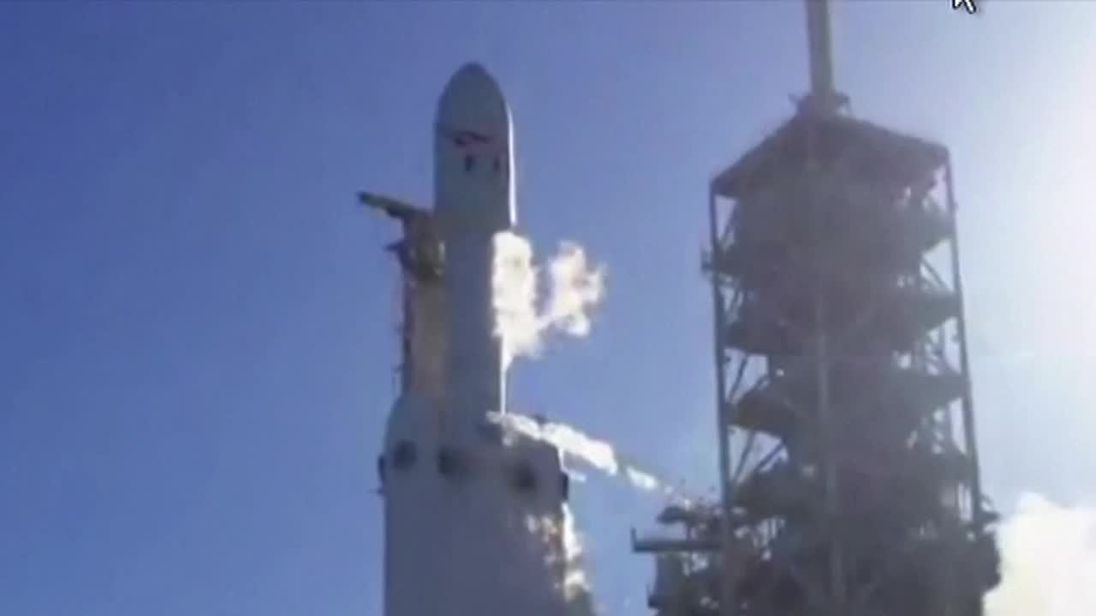
The big moment was delayed for several hours due to high winds and the success of the mission was far from assured.


The world's most powerful rocket has successfully blasted off into space, with the boosters landing vertically back on earth.
Video:SpaceX Falcon Heavy blast-off
Even SpaceX boss Elon Musk admitted it might all end in a ball of flames as the company embarked on its most ambitious launch to date.
The billonaire, who also owns Tesla, used his own car as the test payload - with David Bowie's Space Oddity playing on lift off and a mannequin spaceman in the driver's seat.
:: The Falcon Heavy is a space race game-chanIf it survives the harsh space environment, SpaceX hopes it will enter an Earth-Mars orbit around the sun. The company says the journey could last a billion years.
The impressive sight of the rocket's side boosters peeling away and landing upright and in unison back at Cape Canaveral came soon after launch.But the return to earth of the central booster was less successful. Mr Musk said that it had crashed into the Atlantic at 300mph, missing the floating landing platform.
He said it hit the water with such force that shrapnel flew onto the droneship's deck and took out two engines
Saturn V, which took astronauts to the moon, could handle more payload, as could the Soviet-era Energia.
Never-the-less, the successful test looks set to pave the way for far bigger commercial satellites being put into orbit.


falcon heavy rocket spacex
Image:The rocket's thrust is equal to 18 jumbo jets
The SpaceX rocket has already been booked to launch several large communications satellites and a test payload for US Air Force.
But Elon Musk plans to go further - by the end of the year he wants to send two paying passengers around the moon.
He is not the only billionaire with space ambitions though.
Amazon boss Jeff Bezos also has a spaceflight company, Blue Origin, and is testing out a resuable rocket to fly space tourists to the edge of space.
A larger orbital rocket, New Glenn, is also in the works that will compete against the likes of SpaceX to put satellites into orbit.

Fake doctor in India 'infects dozens with HIV using contaminated needles'


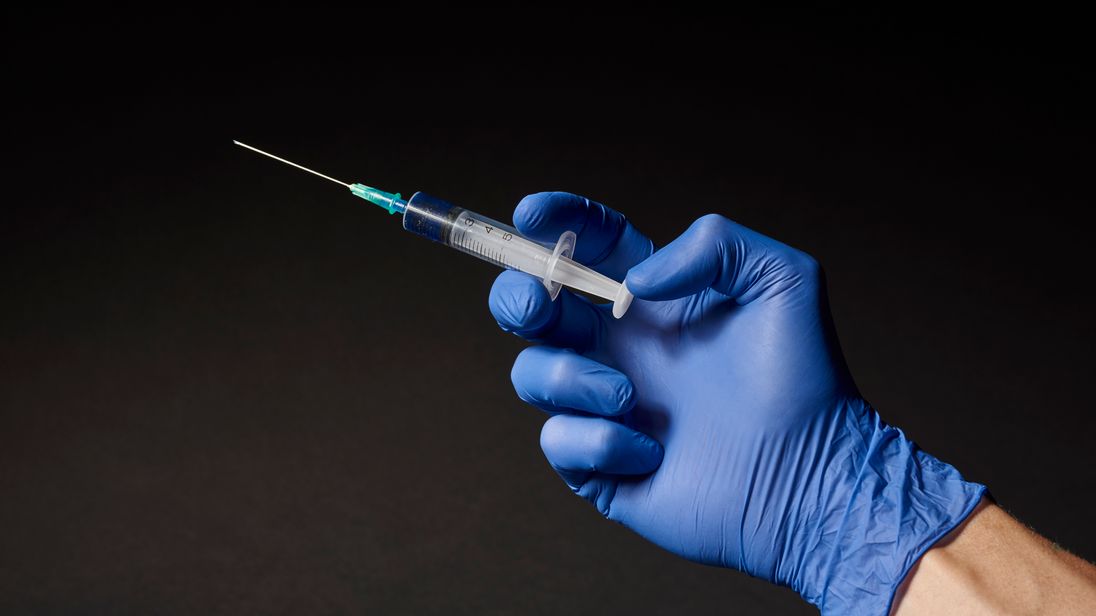
The fake doctor used the same syringes as those he had previously used to treat flu and fever. File pic
Image:Rajendra Kumar is allegedly to have used the same syringes as those he had previously used to treat flu and fever. File pictures.
Thirty-three people have been infected with HIV after a fake doctor allegedly injected them with contaminated needles and syringes.
All of those testing positive are from the north Indian town of Bangarmau, where the unlicensed practitioner was working.
The suspect, Rajendra Kumar, is alleged to have used the same syringes as those he had previously used to treat flu, fever and body ache.
Dr Sushil Choudhary, the district's chief medical officer, told Sky News: "The quack was operating in this rural area and only charged 10 rupees (11p) for an injection.
"He used the same syringe and many poor people went to him for cheaper treatment.
"We have screened 566 persons so far and 38 have been reactive, of these 33 are HIV positive. They have all been sent to the Kanpur Medical Hospital where they are under anti-retroviral therapy and drugs are being administered to stop any progression."
The incident came to light when a government-run health camp was held in the town in November, finding a high number of HIV cases.
India's health department then launched an investigation and set up three screening camps for the town's residents.

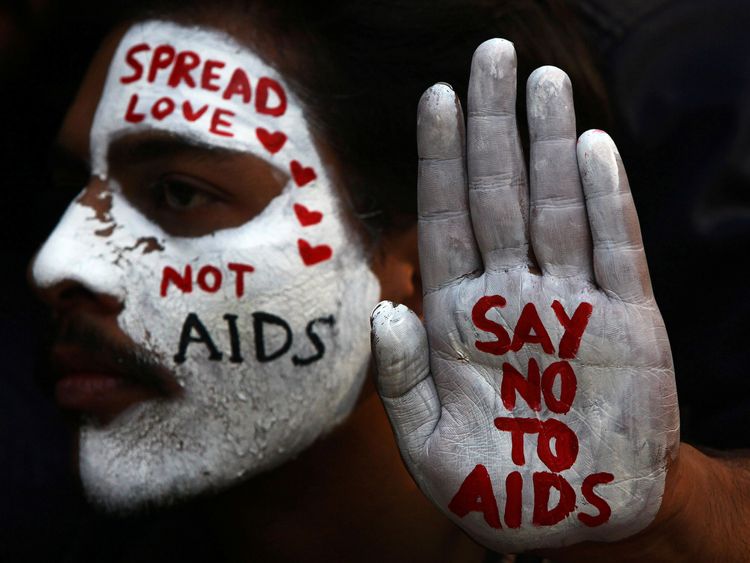
India marks World AIDS Day every December, with the country home to 2.1 million people who live with HIV
Image:India marks World AIDS Day every December, with the country home to 2.1 million people who live with HIV
According to locals, the fake doctor is a resident of a neighbouring village and was claiming to cure people of common illnesses. Because he charged less money, the villagers went to him instead of the government clinic.Dr Choudhary continued: "We have lodged a police case against the quack and have started a crackdown on illegal practitioners who are playing with the lives of people."
Health minister Sidharth Nath Singh added: "Action will be taken against culprits and those who practice without a licence.
"Since it's a transit point, HIV carriers are likely to come there. So we're mapping truck drivers who come there and offer treatment to them."
According to 2017 UNAIDS data, India has 2.1 million people living with HIV, which is about 0.26% of its population. Of those, 9,100 were children under the age of 15.
New HIV infections in the country have decreased by 46% since 2010 and the number of AIDS-related deaths has come down by 22% in the same period
India spends only about 1% of its GDP on public health, leaving millions of citizens no choice but to pursue expensive private treatment.
A disease with expensive treatment costs could easily push a family into poverty, making cheaper cures all the more attractive to the country's most vulnerable.